
The most reliable way to get value from a CNC accessories is to match its core capability to the work you actually run, then confirm the supplier can support it after delivery. For most mold & die and CNC shops the deciding factors are rigidity, the achievable accuracy, and the realism of the specification rather than any single headline number. A machine in this class should be chosen for the process it removes from your bottleneck, not for the brochure. Working with a knowledgeable supply-chain partner keeps the decision grounded in shop reality and protects uptime once the machine is on the floor.
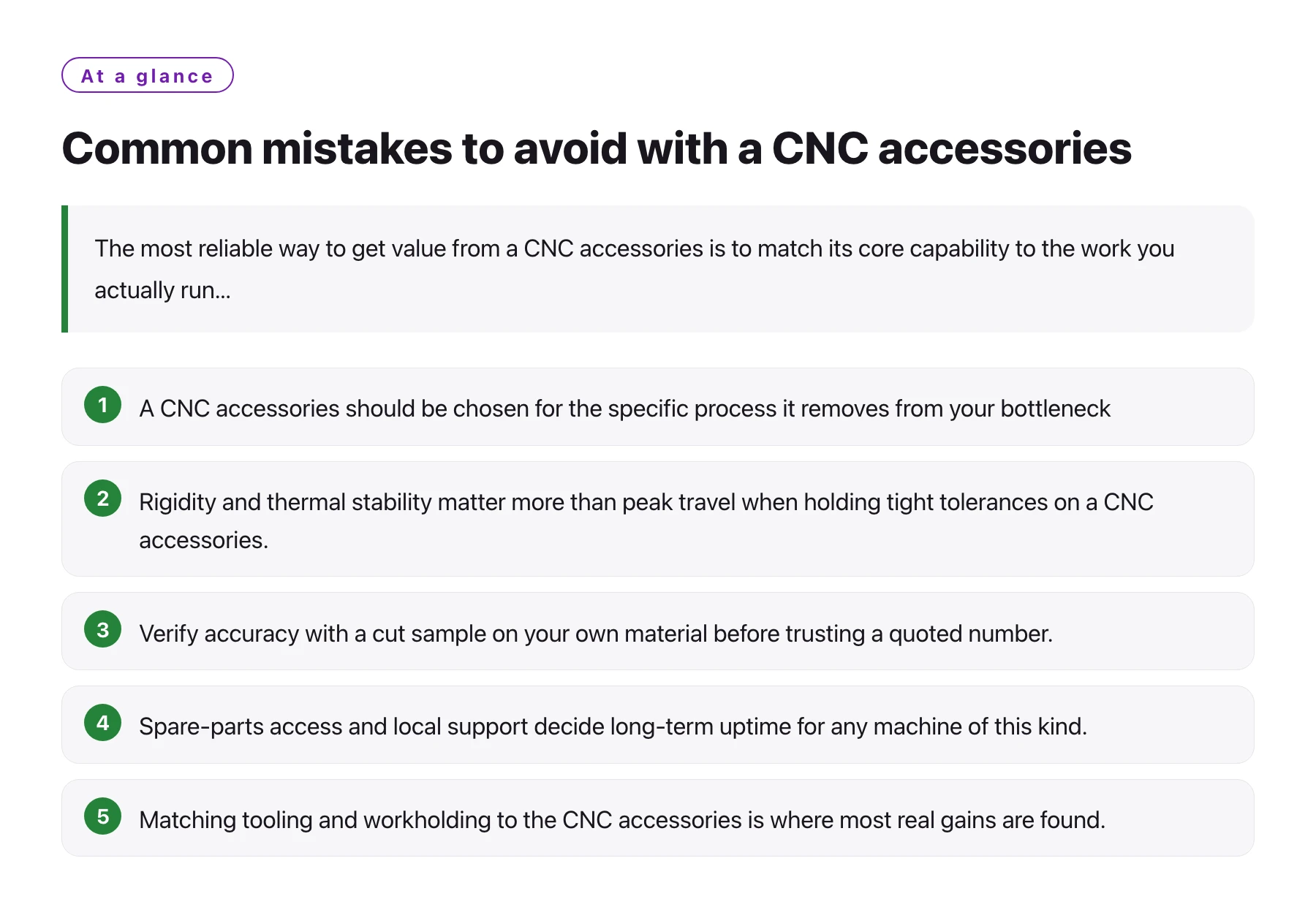
Key takeawaysA CNC accessories should be chosen for the specific process it removes from your bottleneck, not for headline specs. · Rigidity and thermal stability matter more than peak travel when holding tight tolerances on a CNC accessories. [1] · Verify accuracy with a cut sample on your own material before trusting a quoted number. · Spare-parts access and local support decide long-term uptime for any machine of this kind. · Matching tooling and workholding to the CNC accessories is where most real gains are found. · A realistic total-cost view beats a low purchase price when the machine runs for years.
A CNC accessories sits in the middle of modern tool-room and production work because it changes how a shop converts raw stock into finished, dimensionally stable parts. CNC accessories include hydraulic clamping, tooling, vises, and workholding that complete a machining cell. Shops adopt this kind of equipment when manual methods can no longer hold the repeatability their customers demand, or when volume pushes cycle time to the front of every quoting conversation. The machine is only one part of the picture; the cell around it, the tooling, and the people who run it decide whether the investment pays back. That is why a clear buying and operating plan matters before any purchase order is signed.
Much of the confusion around a CNC accessories comes from comparing brochures instead of comparing processes. Two machines can quote the same travel yet behave completely differently on a hard alloy or a thin-walled mold. The differences show up in stiffness, thermal behaviour, and how the controller handles compensation. Buyers who visit a running unit, or who ask a supplier for a cut sample on their own material, learn more in an afternoon than from a week of spec-sheet reading. A good supplier partner will encourage that kind of proof rather than deflect from it.
This article approaches a CNC accessories from the angle of "common mistakes to avoid", so you can apply the thinking directly to your own shortlist. We cover what the equipment is for, the numbers that actually move the needle, and the operating habits that protect both quality and uptime. Along the way we point to established references on machining and safety so the technical claims stay checkable. Whether you are specifying, buying, or maintaining, the goal is the same: a CNC accessories that earns its place on the floor and keeps earning it. ASIATOOLS works with shops as a mold & die supply-chain partner on exactly these decisions through ASIATOOLS.
What a CNC accessories actually does on the floor
A CNC accessories exists to take a specific class of work off manual methods and make it repeatable. CNC accessories include hydraulic clamping, tooling, vises, and workholding that complete a machining cell. The payoff is consistency: the same feature comes out the same on the hundredth part as on the first, which is what mold & die customers ultimately pay for. [1]
It is best understood as one link in a cell rather than a standalone box. It receives sawn or rough-stocked material, performs its operation, and hands a finished or semi-finished part onward. Planning the buffer sizes and the next step keeps the equipment from becoming its own bottleneck.
Mistakes shops regret after delivery
The most common mistake with a CNC accessories is buying the headline number and ignoring the workholding and incoming stock standard it assumes. Without those, the machine cannot reach the accuracy you paid for, and the gap shows up as scrap rather than as a spec failure. [1]
A second regret is skipping the acceptance test. Agreeing on a measured acceptance before installation gives both sides an objective bar, and it prevents the vague disputes that otherwise surface once the CNC accessories is in production and the warranty clock is running.
The specifications that predict real performance
On the spec sheet, the entries that forecast shop behaviour are rarely the biggest numbers. Items such as clamping force, repeatability, and interface standard describe how the CNC accessories behaves under real cutting load rather than in a showroom. [1]
Go further and look at thermal growth and compensation. A machine that quotes a tight figure but drifts as it warms will still cost scrap. Ask for the measurement method behind any accuracy claim, because the same number can mean different things cold, warm, or across the full envelope.
Where it sits in the mold & die workflow
The natural home for a CNC accessories is the step where workholding and tool presetters dominate your lead time. Shops bring one in when that step has become the constraint, because moving it onto a dedicated, repeatable machine frees capacity on both sides at once. [1]
Integration is where the gain is realised. Pair the CNC accessories with the right workholding and a consistent incoming-stock standard, and a one-off improvement becomes a daily habit. For a supply-chain partner such as ASIATOOLS the conversation starts with your part mix and ends with a cell that runs without constant firefighting.
Operating it well: habits that protect accuracy and uptime
Good results from a CNC accessories come from routine more than heroics. Stable fixturing, a clean coolant system, and a short daily check on hydraulic vs pneumatic prevent most failures shops blame on the machine itself, and they preserve the accuracy you paid for. [1]
Safety and quality are linked. A guarded, well-lit, uncluttered setup reduces the rushed decisions that cause both accidents and scrap, and training operators on the specific hazards of a equipment pays back in fewer stops and a machine that stays in calibration longer.
A buying view that survives contact with the floor
Before committing budget, score each candidate CNC accessories against your real part envelope, your peak volume, and the support you can actually get. The cheapest offer often omits the load rating or the spare-parts pipeline that keeps it running, and those gaps surface as downtime within months. [1]
Write the acceptance test before you negotiate so the supplier knows the bar and you have an objective way to accept or reject. This protects both sides and removes the vagueness that leads to disputes after installation, keeping the CNC accessories a planned addition rather than a gamble.
Sources
Frequently asked questions
What is the main job of a CNC accessories?
A CNC accessories takes a specific, repeatable operation off manual methods so parts come out consistent every time. In mold & die work that usually means holding tighter tolerances and faster cycle times than a bench setup allows, which downstream finishing and assembly steps depend on for predictability.
Which specification matters most on a CNC accessories?
The specification that matters most is the one tied to your bottleneck: often rigidity or the thermal behaviour behind the accuracy claim, not the largest travel number. Ask how each figure was measured and under what warm-up condition, because the same quoted tolerance can hide very different real-world performance on a machine of this type.
How do I keep a CNC accessories accurate over time?
Accuracy is preserved by routine rather than by the original calibration alone. A short daily check on fixturing and coolant, a clean workholding surface, and scheduled verification of the compensation values catch drift before it becomes scrap. Training operators on the specific hazards and limits of the machine also protects both people and precision.
When does a CNC accessories stop being worth it?
A CNC accessories stops paying back when its downtime or scrap rate outweighs the capacity it freed upstream. That usually traces to missing spare-parts access, poor workholding, or a mismatch with the actual part mix. Revisit the process step it was bought for and confirm the machine still owns the right bottleneck before investing further.