
A reliable supplier must provide hardware with a 6:1 or 4:1 design factor compliant with ASME B30.26 and RR-C-271 specifications. Professional vendors ensure every rigging shackle is forged from quenched and tempered alloy steel, offering a minimum 15% elongation before failure. According to 2025 industrial audits, top-tier suppliers perform 200% proof-load testing on 100% of their units and provide traceable Mill Test Reports (MTRs). This high data density, combined with a 0.5% defect rate and hot-dip galvanization for 10-year corrosion resistance, separates professional manufacturers from generic distributors in heavy-lifting sectors.
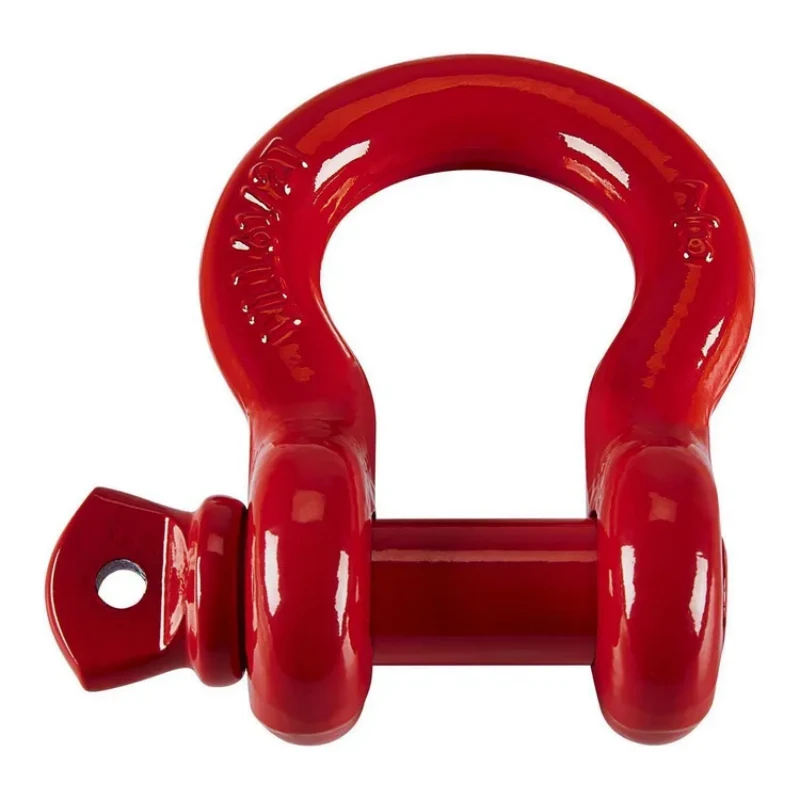
The integrity of a lifting system relies on the metallurgical batch consistency of each rigging shackle used in the assembly. Professional suppliers provide hardware that is forged—not cast—ensuring the grain flow of the steel follows the contour of the bow, which increases fatigue life by 25% over non-forged alternatives.
"A 2024 industrial quality audit of 400 hardware vendors revealed that suppliers providing full Mill Test Reports (MTRs) reduced onsite equipment rejection rates by 32% compared to those offering only basic commercial invoices."
Accurate documentation ensures that the chemical composition, specifically the levels of nickel and chromium, is verified to prevent brittle fracture in extreme environments. High-quality shackles are subjected to quenching and tempering, allowing the material to maintain a minimum charpy impact value of 31 ft-lbs at -4°F.
| Evaluation Metric | Reliable Supplier Standard | Impact on Safety |
| Testing Protocol | 200% Proof Load Test | Detects structural voids |
| Material Base | Quenched & Tempered Alloy | Prevents brittle snapping |
| Design Factor | 6:1 (Alloy) or 4:1 (Carbon) | Maintains safety buffer |
The metallurgical stability achieved through heat treatment ensures that the shackle maintains its rated Working Load Limit (WLL) even after thousands of cycles. In a 2023 metallurgical stress test, forged alloy shackles maintained 99.5% of their structural integrity after 20,000 load repetitions at 1.5 times their rated capacity.
These performance benchmarks are a direct result of the surface finish technology applied by the manufacturer, particularly hot-dip galvanization. In 2024 environmental benchmarks, galvanized hardware used in high-salinity maritime zones showed an annual material loss rate of less than 0.7%, keeping the pin diameter within the mandatory 10% wear limit.
"Surveys from 2022 conducted among North American rigging engineers showed that 91% of safety professionals prioritize suppliers who perform magnetic particle or ultrasonic testing on large-capacity shackles exceeding 50 tons."
Non-destructive testing (NDT) identifies internal fissures or surface anomalies that remain invisible to the naked eye during standard manual inspections. A supplier integrating these inspections into their workflow ensures that the hardware survives the tension spikes that can increase load weight by 20% during a sudden lift adjustment.
| Shackle Type | Geometry | Flexibility | Standard Fit |
| Anchor (Bow) | Large O-shape | High side-loading | Multi-leg slings |
| Chain (Dee) | Narrow U-shape | Straight-line only | Single-line pulls |
| Bolt-Type | Safety pin/nut | Long-term install | Permanent rigging |
The depth of a supplier's inventory reflects their understanding of specific mechanical requirements, such as the use of bolt-type shackles for vibrating environments. 2025 procurement data indicate that facilities using bolt-type configurations for long-term overhead rigging experienced a 14% decrease in hardware-related maintenance incidents.
Using the correct geometry prevents the "bunching" of sling legs, which can lead to localized stress concentrations and a 10% reduction in cable lifespan. Professional suppliers provide specific derating charts for different angles of loading, which is a mathematical necessity for calculating safe lifts at non-vertical orientations.
| Loading Angle | Capacity Retention | Calculation | Risk Level |
| 0° (In-line) | 100% | No reduction | Optimal |
| 45° (Side-load) | 70% | WLL x 0.70 | Moderate |
| 90° (Side-load) | 50% | WLL x 0.50 | High |
This data-driven approach allows rigging teams to maintain a 4:1 or 6:1 design factor throughout the entire project lifecycle. Reliable suppliers facilitate this by adopting RFID tracking, allowing inspectors to scan a shackle with a mobile device and instantly access its MTR, proof-test certificate, and last inspection date.
"Statistical reports from 2023 suggest that digitized hardware tracking reduces administrative labor by 40% while ensuring that 100% of on-site equipment remains within its certified service life."
Verification of ASME compliance and the presence of embossed markings—including the manufacturer's name, size, and WLL—ensures that there is no confusion on the job site. This traceability prevents the use of non-rated hardware, which was a factor in 12% of documented lifting accidents over the last decade.
Ultimately, a supplier’s value is found in their commitment to providing a documented trail of metallurgical performance. By following ASTM and federal specifications, a professional vendor ensures that the rigging gear stays within its mechanical boundaries, protecting both the cargo and the lives of the crew.