
Breaker Room Arithmetic Before You Add a Second Mining Room
A second mining room is an electrical decision long before it is a mining decision. One petahash running at 20 J/TH pulls roughly 20 kW, and at the 21 September 2026 network rate it settles 0.00044861 BTC a day — 0.00134582 BTC across three days, worth $113.98 at $84,692. The panel must carry that load every hour; the pool only has to count the shares.
Key takeaways
- 1 PH/s at 20 J/TH is about 20 kW, or 480 kWh a day before fan power and conversion losses.
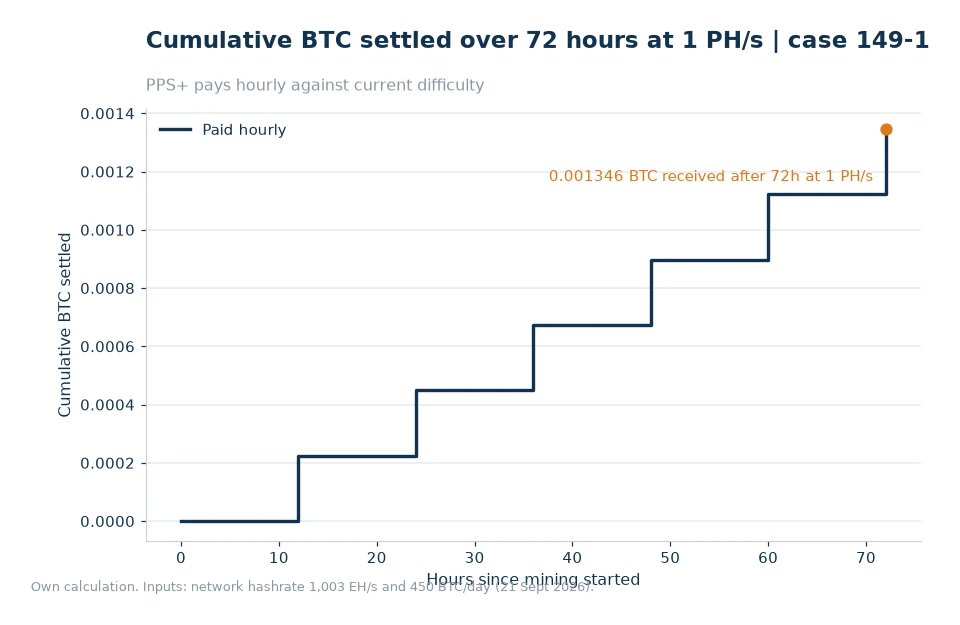
- PPS+ credits 0.00001869 BTC an hour at that hashrate, so each checkpoint on the 72-hour curve is 0.0002243 BTC.
- Three days of credits reach 0.00134582 BTC, which converts to $113.98 at $84,692 per BTC.
- Keep the continuous draw under 80% of the breaker rating, or the second room becomes a nuisance-trip problem.
Why three days is long enough to judge a room
Seventy-two hours covers three full difficulty days, one weekend of whatever the local grid does, and enough thermal cycles for a marginal fan or a tired power supply to show itself. A shorter test tells you the machines booted. A longer one costs you the option to change your mind before the second batch of hardware arrives.
The 72-hour figure also lines up with how PPS+ behaves. The block-reward component settles hourly against current difficulty, so the credit curve is a staircase rather than a smooth line. Six step-ups per day, each one 0.00001869 BTC at 1 PH/s, make a gap in the log obvious within an afternoon. That is the practical value of a three-day window: a missing step is easy to see, while a slightly smaller month is not.
What the service panel says before the payout screen does
Start with the main breaker and work outward. A 20 kW load on a 240 V single-phase feed is about 83 A, which means a 100 A breaker is technically adequate and practically tight. Most electricians will want the continuous load held near 80% of the rating, so that same 20 kW really wants a 125 A circuit or a three-phase feed where the current per leg drops.
Two details get missed in a first survey. The first is diversity: a panel rated for 200 A does not deliver 200 A if the house, the well pump and the air handler share it. The second is heat. A room drawing 20 kW of compute rejects close to 20 kW of heat, and the fans that move it out draw power too, so the meter at the wall reads higher than the miner dashboard suggests. Budget the fans into the load, not into a separate column you forget to add.
If the survey comes back short, the honest options are a service upgrade, a smaller first batch, or a hosted slot. The last one is worth pricing rather than dismissing: ViaBTC Mining Farms lists facilities that take third-party machines, which turns a panel limit into a monthly line item instead of a construction project.
Credits at twelve-hour marks
The table follows one petahash from switch-on to the end of the third day. Every row assumes continuous uptime and the difficulty reading from 21 September 2026.
| Checkpoint | BTC credited | Value in USD | Share of the 72-hour total |
|---|---|---|---|
| 12 hours | 0.0002243 | $19.00 | 16.7% |
| 24 hours | 0.00044861 | $37.99 | 33.3% |
| 48 hours | 0.00089721 | $75.99 | 66.7% |
| 72 hours | 0.00134582 | $113.98 | 100% |
Read the share column against your own meter readings. If the room is drawing its expected 20 kW but the credits are arriving at 80% of this pace, the shortfall is in the hashrate, not in the power. If the credits are correct and the draw is above expectation, the problem is thermal or electrical and it will show up on the next invoice.
Worked example
Follow one petahash through the whole chain, including the part the pool never bills you for.
- Network output per terahash: 450 BTC ÷ 1,003,000,000 TH/s = 0.00000044865 BTC a day.
- One petahash is 1,000 TH/s: 1,000 × 0.00000044865 = 0.00044861 BTC a day.
- Hourly credit: 0.00044861 ÷ 24 = 0.00001869 BTC.
- Twelve hours: 12 × 0.00001869 = 0.0002243 BTC, or $19.00 at $84,692.
- Seventy-two hours: 72 × 0.00001869 = 0.00134582 BTC, or 0.00134582 × 84,692 = $113.98.
- Electrical side at 20 J/TH: 1,000 TH/s × 20 J = 20,000 W, or 20 kW; 20 kW × 24 h = 480 kWh a day.
- At $0.06 per kWh that is $28.80 a day. Gross output is $37.99, the listed 4% on the block-reward part takes about $1.52, leaving $36.47 before power — and $7.67 after it.
Cooling is a load, not an afterthought
Every kilowatt that leaves the miners as heat has to leave the room. In a cold climate that might be a fan and a vent; in a warm one it is a compressor, and a compressor changes the margin faster than a difficulty adjustment does. A 20 kW hall with a cooling system that consumes 3 kW is really a 23 kW hall, and the daily power bill is built on 552 kWh rather than 480.
The cheap measurement is a thermometer at the intake and another at the exhaust. A rise of more than about 10 °C across the rack means the air is being reused rather than replaced, and the miners will compensate by spinning fans faster and hashing less. That shows up as a hashrate line that sits just under the rated value all day, which is easy to mistake for a pool problem.
Fix the airflow before adding machines. Ducting the exhaust away from the intake and leaving a clear metre in front of each rack usually recovers most of the missing hashrate, and it costs nothing but an afternoon. Paying for a larger cooling unit to solve a layout problem is the expensive version of the same repair.
The difficulty estimate is the only soft number
Everything above rests on a reading taken on 21 September 2026, including the estimate of a 2.12% downward adjustment at the next window. If that estimate holds, output per petahash rises by roughly 2.17%, which is about 0.0000097 BTC a day, or $0.82. Over a month that is $24.60 — real money on a small site, but not enough to rescue a panel that is already overloaded.
Treat the estimate as a direction, not a promise. A negative adjustment helps the margin slightly; a positive one hurts by a similar amount. Neither changes the amperage, which is why the electrical survey should come first and the difficulty forecast second. One is a hard limit; the other is weather. The pool state page carries the live network figure when the estimate is superseded.
Frequently asked questions
How much power does a 1 PH/s mining room draw?
At 20 J/TH it draws about 20 kW, or 480 kWh a day, and cooling fans or compressors add to that figure; at 25 J/TH the same hashrate needs 25 kW and 600 kWh a day.
Does a hosted slot change the 72-hour credit figure?
No. The 0.00134582 BTC total comes from hashrate against difficulty, so it is the same in a garage or a managed hall; hosting changes the cost line and who answers when a board fails.
Should I wait for the difficulty adjustment before building out?
The estimate of a 2.12% cut is worth perhaps 0.0000097 BTC a day per petahash, about $0.82, which is small next to a service upgrade; use it to refine the plan, not to delay the electrician.
Bring the ammeter to the site visit
Write two numbers on one sheet: the spare continuous amperage at the panel, and the daily credit at your planned hashrate. Convert the first into kilowatts, convert the second into dollars, and subtract the power bill. If the result stays positive with the fans running and a difficulty rise in the model, the second room is sound. The Profit Calculator will produce the credit line; the amperage is a job for someone with a clamp meter.
Sources: ViaBTC's fee and farms pages, for the 4% listed on the block-reward stream and for the hosting listings[1]. Readings taken 21 Sept 2026 — 1,003 EH/s network hashrate, 3.125 BTC subsidy, 144 blocks daily, coin at $84,692, next adjustment estimated at −2.12%. Source figures read 21 Sept 2026, published 24 Oct 2026. Credits assume the machines never stop.